
Line of Sight
A light sculpture that answers the way you move in front of it
- Embedded electronics
- C++ firmware
- Computer vision
- Interactive installation
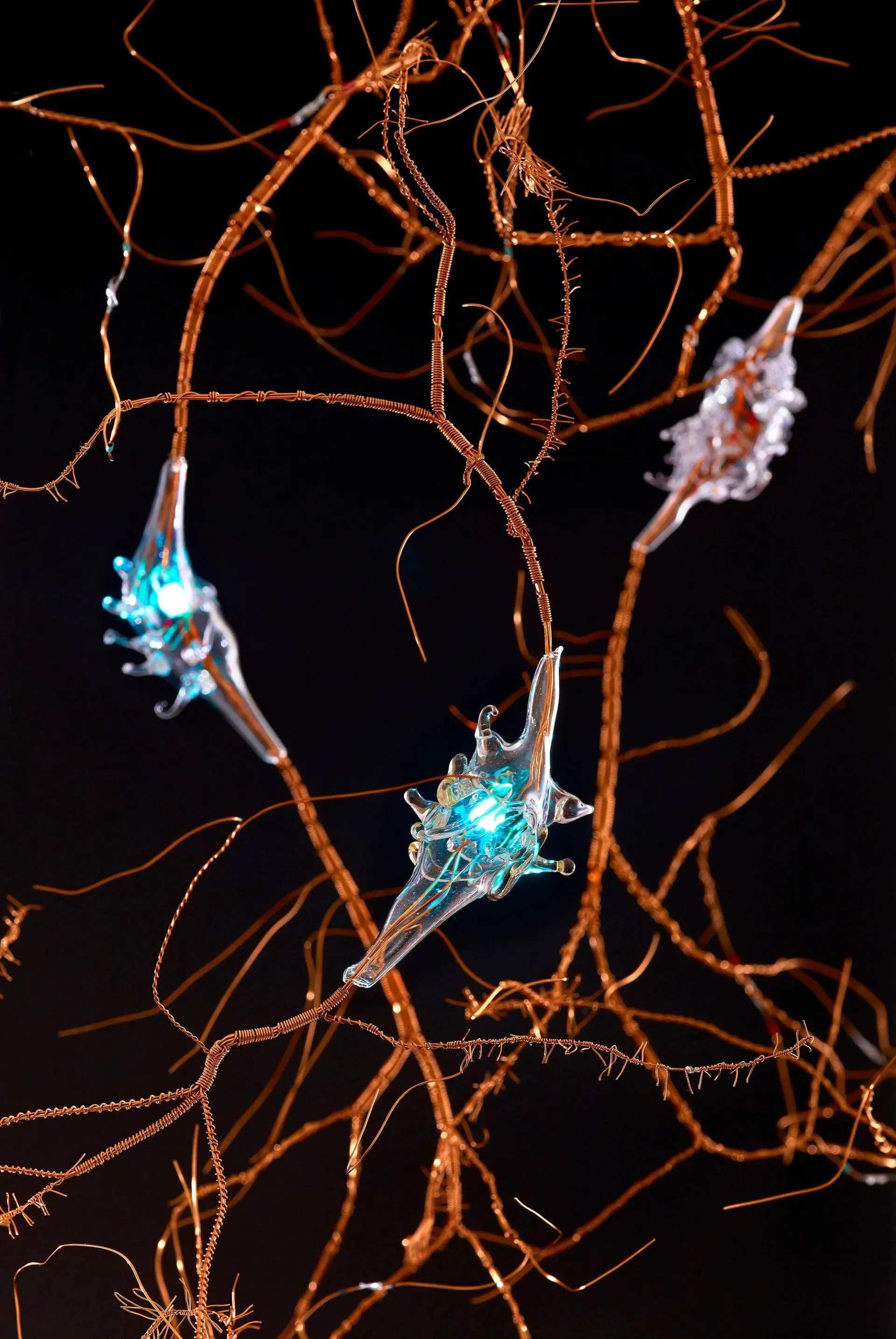
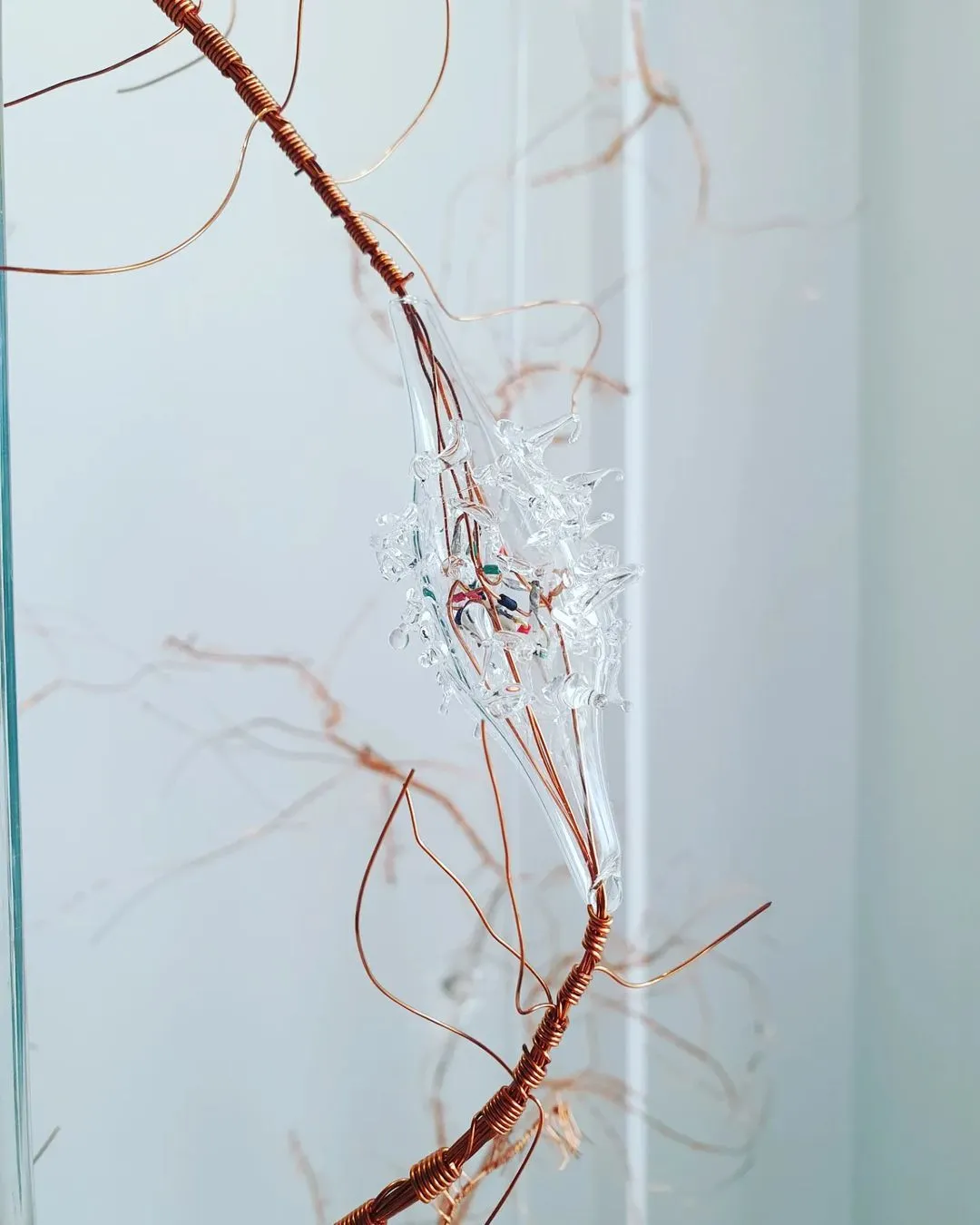
Line of Sight is a light sculpture made in collaboration with the artist Jenny Walsh, installed at the Sainsbury Wellcome Centre in London. Glass forms grow out of branches of coiled copper wire, each one holding a small cluster of LEDs. A camera watches the space in front of the piece and turns what moves there into light: movement in one direction sends a cascade of illumination along one set of branches, movement in another sends it along another.
The glass and copper forms are Jenny’s. My contribution was the electronics driving the camera and the LEDs, and the C++ firmware that reads the camera and sequences the light.
Borrowing the visual cortex
The sculpture is built around a piece of neuroscience rather than a decorative effect. In the retina, cells respond to light itself; further along the visual pathway, neurons in the primary visual cortex respond selectively. A given neuron fires most strongly when its patch of the visual field holds an edge at a particular orientation, or motion in a particular direction, and neighbouring neurons prefer neighbouring orientations. The cortex ends up organised as a map of features rather than a map of the world.
Line of Sight takes that arrangement literally. The LED clusters stand in for columns of neurons, and each column is tuned to one class of movement: horizontal, vertical or diagonal. Which ones fire is decided by what the camera sees, not by a prerecorded sequence.
Reading the room
A camera faces the space in front of the sculpture and streams frames to the electronics behind it. There is no depth sensor and no marker on the visitor; the firmware works only from what is in the image. It reduces each frame to the edges it finds and the direction they are travelling, then classifies the result as horizontal, vertical or diagonal movement.
A classification lights a set of columns, but never all at once. The firmware sends the response out as a cascade, node after node along the copper branches, so the piece appears to conduct the movement along its own structure rather than switching on as a panel.
The viewer in the loop
Nothing on the piece is labelled. A visitor arrives, moves, and something answers; it is only by continuing to move that the relationship between their body and the light becomes clear. Move horizontally and one set of columns fires. Move vertically and a different set takes over, with diagonals between them.
The intent is that this arrives as a realisation rather than an instruction. As a model of selective response, the piece gives the visitor the role of the signal: once the connection is made, people tend to change how they move — slower, more deliberate, testing where one class of movement ends and the next begins — and the columns answer accordingly.
It also suits the building it lives in. Someone crossing a busy atrium does not read a caption first, so the piece has to make its own cause and effect legible quickly enough to catch a passer-by, and reward them with more when they stop to experiment.

Visitors with the piece at the Sainsbury Wellcome Centre. 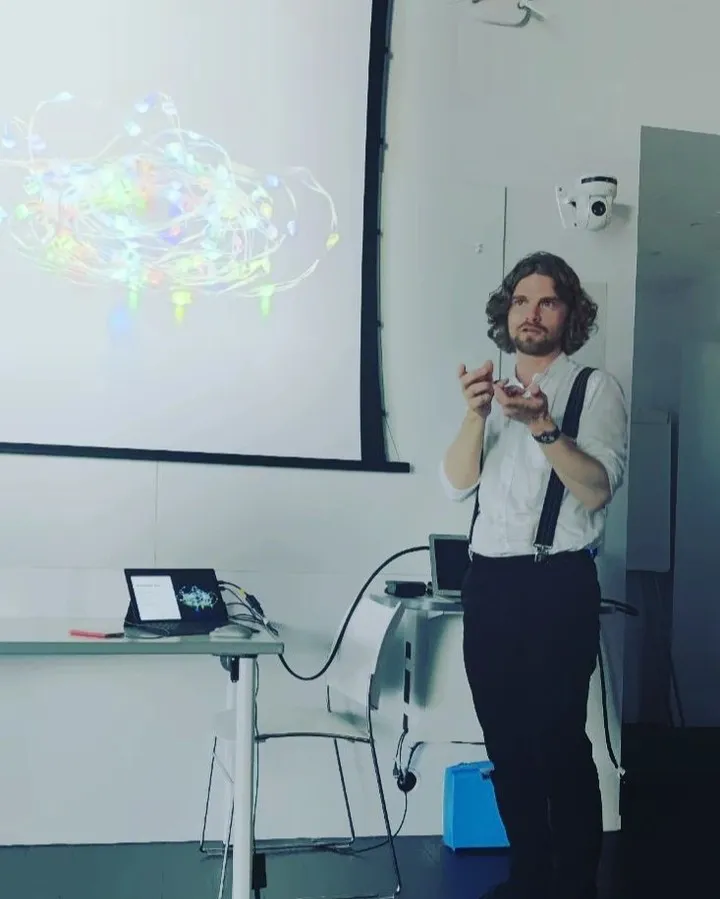
Talking about Line of Sight at the Sainsbury Wellcome Centre. 
The exhibition flyer.